
The Role Won
The traits that earn someone a promotion are often the ones the new role quietly punishes. Organizations pull people toward the center. If you don't design the role to preserve what made someone exceptional, the role will reshape them into someone safer and less effective.
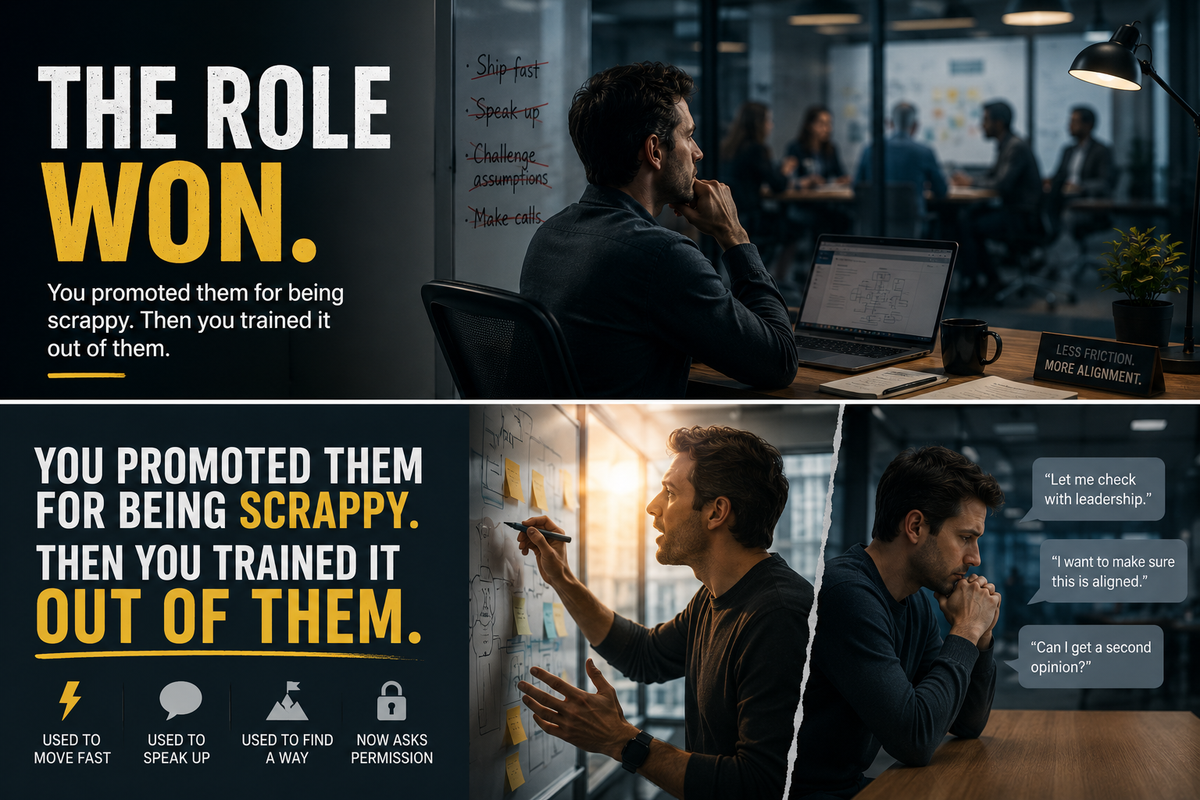
You promoted someone because they were scrappy, opinionated, and moved fast. Six months later they're slower, quieter, and asking permission for things they used to just do.
You didn't hire the wrong person. You built the wrong container.
I've watched this happen more times than I'd like to admit. A strong individual contributor gets recognized, gets the title, gets the new responsibilities. Everyone is excited. And then, gradually and almost invisibly, the thing that made them stand out starts to disappear. They become more careful, more measured, more acceptable. And you're left wondering what happened to the person you promoted.
Nothing happened to them. The role happened to them.
The traits that earn promotions are often the traits the new role punishes
Think about what actually earns someone a promotion. They ship things without being asked. They push back when something is stupid. They find a way around obstacles instead of waiting for someone to remove them. They have opinions, and they voice them, sometimes loudly, sometimes at inconvenient moments.
Those traits are magnetic when someone is an individual contributor. They create momentum, make work happen, and are the reason you noticed this person in the first place. Then they get promoted, and suddenly those same traits create friction. Their peers want more polish before ideas get shared. Their direct reports want consistency and calm instead of someone charging ahead and changing direction every two weeks. Their manager wants process, documentation, and alignment.
The organization, in a hundred subtle ways, starts signaling that the old behavior is no longer appropriate. So the person adapts. Of course they do. They're smart. They read the room, sand down the edges, slow down, and start asking for permission. And eventually you lose the exact thing you promoted them for.
That's not a character flaw. It's a rational response to a new set of incentives.
Organizations are gravity
Organizations pull people toward the center. Not because anyone is malicious, not because there's a conspiracy to make everyone mediocre, but because conformity is the path of least resistance and most systems are quietly optimized to reward it.
When someone steps into a new role, they get hit with new expectations from every direction at once. Each expectation is individually reasonable. Together, they create enormous pressure to become more predictable, more deferential, more careful. Someone safer.
Underneath all of that is fear. Not dramatic fear, but the professional survival kind. Fear of being seen as difficult. Fear of sounding immature. Fear of creating friction with peers. Fear of becoming the person people quietly describe as hard to work with. Most people don't consciously decide to become more cautious. They just slowly realize they no longer feel safe being the person who got them promoted in the first place. That shift rarely happens all at once. It happens the way water shapes rock, and you don't notice it until it already has.
This is the structural problem most managers never name. We treat it like a people problem instead. We wonder whether the person is struggling with the transition, whether they need coaching, whether they were really the right fit after all. Meanwhile, the actual issue is that we handed someone a role without thinking carefully about what that role would do to them.
The objection worth taking seriously
Some of those traits genuinely do need to evolve. A senior engineer who never learned to slow down and bring people along is going to struggle as a tech lead. A scrappy individual contributor who never develops the ability to build consensus can create real chaos at a management level. That part is real.
But there's a difference between helping someone develop new skills and accidentally training them to abandon the ones that made them effective. The goal should be addition, not replacement. You want someone who can move fast and bring people with them, who has strong opinions and knows how to make those opinions land, who still has a bias toward action but has learned to use it strategically.
Most organizations are not doing the first thing. They're doing the second without realizing it. They're not intentionally coaching someone into becoming more timid. They're just not doing anything to prevent it, and the organization fills that vacuum with its own preferences.
What intentional role design actually looks like
The fix has to happen before the promotion, not six months after the damage is already visible. By the time you're sitting across from someone wondering where their edge went, you're already in recovery mode.
Start by naming the traits you want to preserve, and write them down explicitly. Not in a vague "we value initiative" kind of way. Specifically. This person moves fast and makes decisions without waiting for consensus. This person challenges assumptions, including yours. This person has a low tolerance for process that exists only to protect itself. Those are the traits you're promoting, and they should show up in how the role is defined.
Then build those traits into the expectations intentionally. If you want someone to keep moving fast, the role has to leave room for that, which means being clear about where they have authority to act without checking in and defending that authority when people push back on it. If you want them to stay opinionated, you have to create conditions where disagreement is treated as useful instead of disruptive.
And before they step into the role, have a direct conversation with them about the pressure they're about to experience. Not a generic "here's what success looks like" conversation. Tell them what you're worried about. Tell them you've seen this happen before, where someone gets promoted and slowly gets reshaped into someone more cautious and less effective. Tell them you don't want that to happen to them, and ask them to tell you if they start feeling pressure to become someone they're not. That conversation matters more than most managers realize. It gives the person permission to notice the pressure instead of quietly adapting to it.
What you have to do after the promotion
Role design doesn't end when the title changes. Watch for the early signs. Are they slowing down in ways that don't make sense? Are they hedging more? Are they bringing you decisions they would have confidently handled six months ago? Those aren't always signs of maturity. Sometimes they're signs that the organization is doing what organizations naturally do.
When you notice it, name it directly, not as criticism but as information. "I've noticed you've been checking in more before making calls. What's driving that?" Sometimes there's a legitimate reason. Sometimes they'll tell you they're getting signals to be more careful, and you'll discover exactly where the pressure is coming from.
Then comes the part most managers avoid. You have to be willing to push back on the organization on their behalf. That means talking to the peer who complained about the person's communication style and explaining that directness is not automatically dysfunction. It means pushing back when unnecessary process starts slowing them down. It means absorbing some friction yourself so they don't have to carry all of it alone. Protecting someone's best traits requires actual effort. Most organizations will not preserve those traits by default.
The close
Most organizations don't lose exceptional people all at once. They slowly sand down the traits that made those people exceptional in the first place. The role wins quietly, not through one dramatic failure but through a thousand small signals about who the person is supposed to become now.
You didn't promote them to watch them become safe. Figure out what made them dangerous in the best possible way, and then build a role that keeps that alive.
Tech Leadership Made Simple — the practical guide for leaders who want to build environments where good people stay good, not just stay.