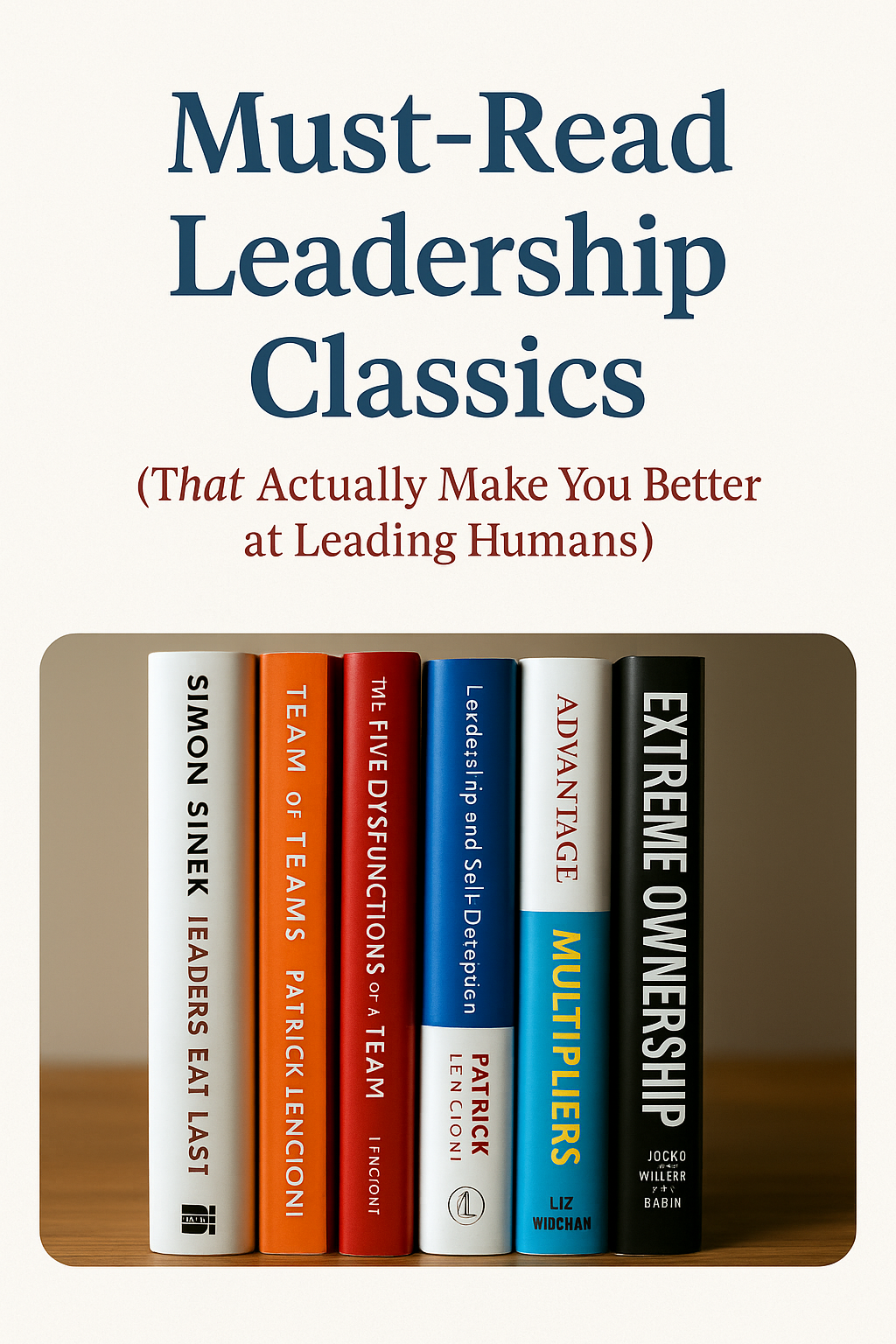
Must-Read Leadership Classics (That Actually Make You Better at Leading Humans)
If you’ve been in tech long enough, you’ve probably met at least one leader who thinks “leadership development” means buying a whiteboard and speaking in buzzwords. Unfortunately, that person might even be your boss.
Real leadership isn’t about jargon, performative empathy, or doing a TED Talk impression in meetings. It’s about understanding people, starting with yourself, and building a team that can operate like adults who trust each other.
These books actually help with that.
Below are the foundational leadership books I recommend to any new (or seasoned but self-aware) leader. These aren’t fads. These aren’t “I read this, so you should too” corporate requirements. These are the books that stick with you because they change how you approach your work, your team, and yourself.
Affiliate Disclosure
Some links in this post are Amazon affiliate links. If you buy through them, I might earn a tiny commission, basically enough to fuel my caffeine addition while I write the next post.
1. Leadership and Self-Deception
The Arbinger Institute
https://amzn.to/44UOI7o
This is the book I wish every new leader would read before managing people. The premise is simple but uncomfortable: sometimes you are the problem. Not your team. Not the process. You.
It walks through the concept of “being in the box”, a mindset where you stop seeing your team as humans and start seeing them as obstacles, objects, or threats. Once you’re “in the box,” every decision becomes a reaction, not intentional leadership.
Biggest Takeaway
If you don’t understand your own blind spots and biases, you can’t lead anyone effectively. Self-awareness isn’t optional. It’s the job.
2. The Five Dysfunctions of a Team
Patrick Lencioni
https://amzn.to/3KCYT9J
This one reads like fiction but punches like a leadership textbook. Lencioni breaks down the five core reasons teams fail:
- Absence of trust
- Fear of conflict
- Lack of commitment
- Avoidance of accountability
- Inattention to results
It’s like a diagnostic tool for team dysfunction. If your team struggles in one area, odds are that something below it is broken too.
Biggest Takeaway
Trust is the foundation of everything. Without trust, nothing else sticks, not accountability, not ownership, not performance. If you want to fix a struggling team, start there.
3. Team of Teams
General Stanley McChrystal
https://amzn.to/4oDqUw0
Before you roll your eyes at the military reference, this book is incredibly relevant to modern tech leadership. McChrystal shows how tightly controlled, hierarchical systems fall apart in fast-moving environments. Sound familiar?
Successful organizations operate like networks: empowered people, shared context, rapid communication, decentralized decision-making.
Biggest Takeaway
Your job isn’t to control everything. It’s to make sure your team has the clarity, trust, and autonomy to move quickly without you.
4. Leaders Eat Last
Simon Sinek
https://amzn.to/48laC64
Yes, Sinek gets quoted a lot, but this one is worth the hype. He connects biology, psychology, and leadership in a way that makes sense without pretending he invented empathy.
The concept is simple: great leaders create safe environments where people can do their best work without fear of being thrown under the bus.
Biggest Takeaway
Leadership is service. When your team feels protected, supported, and trusted, they take risks, innovate, and push boundaries. When they don’t, everything slows to a crawl.
5. The Advantage
Patrick Lencioni
https://amzn.to/48oimnV
This is the “how-to manual” for organizational health. Lencioni argues that the healthiest organizations, not necessarily the smartest or most efficient, win over the long term. And honestly? He’s right.
He breaks down practical steps for creating alignment, clarity, and cohesion inside any team.
Biggest Takeaway
Confusion is expensive. Clarity is powerful. Leaders who over-communicate win far more often than leaders who assume everyone “gets it.”
6. Multipliers
Liz Wiseman
https://amzn.to/4a1Igz4
This book will either make you feel validated… or personally attacked. Wiseman breaks down two types of leaders:
Multipliers — leaders who amplify their team’s intelligence
Diminishers — leaders who unintentionally (or intentionally…) squash it
Every leader thinks they’re a Multiplier. Spoiler: many are not.
Biggest Takeaway
Your job isn’t to be the smartest person in the room. It’s to make other people smarter. Multipliers create environments where people grow. Diminishers create bottlenecks.
7. Extreme Ownership
Jocko Willink & Leif Babin
https://amzn.to/3Ydw7Qe
Another military one, but again: wildly applicable to tech. The core concept? Blame is easy. Ownership is leadership. When things go wrong (and they will), great leaders look inward, correct the system, and move forward.
Biggest Takeaway
Accountability starts at the top. If your team missed the mark, your job is to remove obstacles, clarify expectations, and lead the course correction, not point fingers.
Want the full list?
I keep an updated and expanded version of this list here:
👉 https://benable.com/nickmullins/my-favorite-book-recs-ac
Wrapping Up
These books shaped the way I lead, not by telling me how to “act like a leader,” but by helping me understand how teams actually function and how humans actually respond to leadership.
You don’t need a fancy title to lead well. You need self-awareness, clarity, and the willingness to be wrong sometimes (which, let’s be honest, happens more often than any of us would like).
If you want to go deeper, stay tuned. This is Post #1 in a multi-part leadership series.
Next up: Books That Make You a Better Communicator (and Less Likely to Accidentally Start a Fire).
Hey, since you made it this far, you might actually care about becoming a better leader.
Good news: I wrote an ebook that’ll help you skip years of trial and error.



Comments ()