
How to Survive in Legacy Codebases Without Losing Your Skills
Legacy codebases feel like haunted houses, every file hides a ghost from the past. But instead of letting them drain your skills, you can turn debugging, small refactors, and a sense of humor into survival strategies. Here’s how to thrive when your day job is more archaeology than architecture.
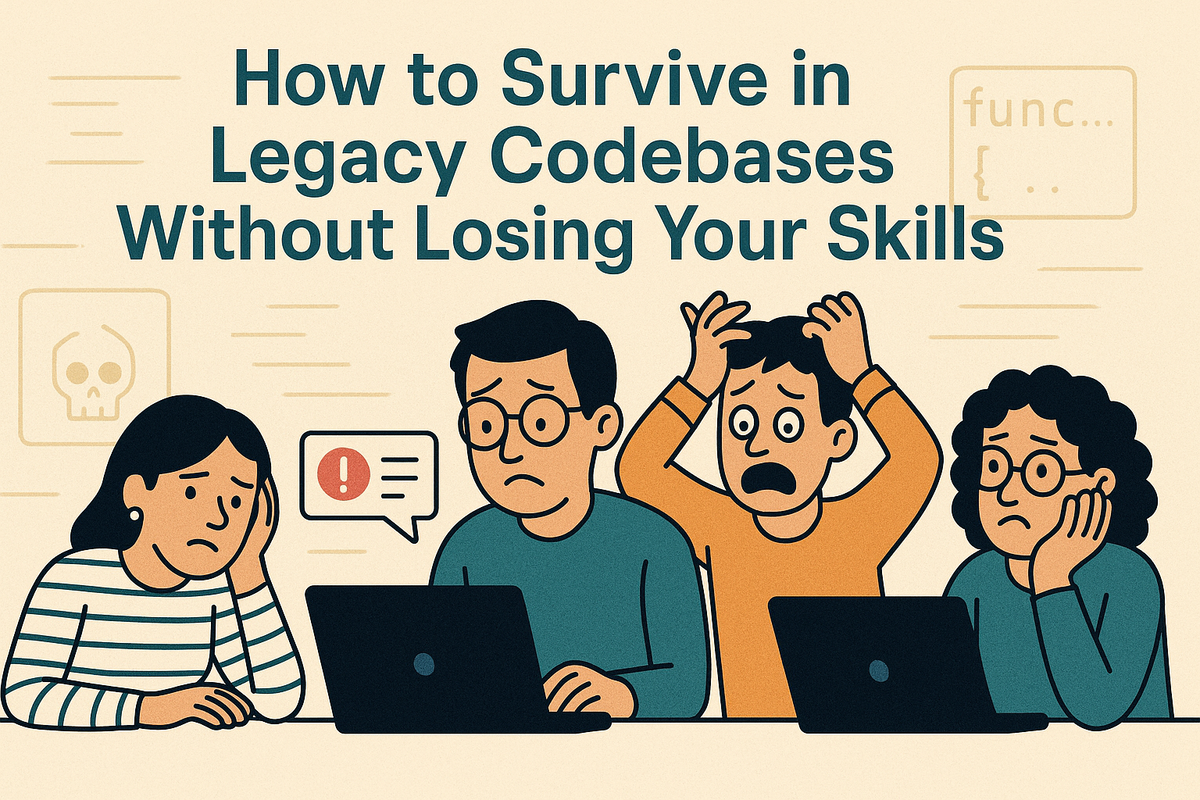
Working in a legacy codebase is like moving into a haunted house. At first, you think it can't be that bad. Then you open a file and find a function written in 2004 that still controls your login flow. Suddenly, you're navigating the design decisions of developers who thought global variables were a personality trait and documentation was for quitters.
It's not glamorous. It's not greenfield. And if you're not careful, it can quietly eat away at your skills until you're nothing more than a bug patcher who prays nothing new ever gets added.
It doesn't have to go that way.
Stop complaining, start cataloging
Yes, the code is bad. You're not the first to notice. Complaining won't fix it, and pretending it's fine won't either. What you can do is start cataloging what you find. Keep a running list of the WTF moments, the spaghetti dependencies, and the hotspots where everyone is scared to make changes.
This isn't just venting. It's data. Data becomes refactor tickets, team discussions, and eventually better systems. You might not get to fix it today, but you're leaving breadcrumbs for yourself and for whoever inherits this after you. That's a contribution, even if it doesn't feel like one.
Treat debugging as training
Tracking down a bug through three layers of nested XML configs and undocumented side effects is miserable. It's also some of the best problem-solving practice you'll ever get. You're building pattern recognition, problem decomposition, and a resilience to ambiguity that greenfield developers don't develop the same way.
Developers who've only worked in clean, well-documented codebases know how to follow a map. Developers who've survived legacy systems know how to navigate when there isn't one. That's a real skill, and it transfers everywhere.
Add guardrails without overhauling
You're not rewriting the monolith this quarter. Accept that early and save yourself a lot of frustration. What you can do is add small guardrails as you go: unit tests around the riskiest functions, linting rules that prevent new problems from being introduced, better logging so the next person has something to work with.
Legacy code doesn't need a hero with a sword. It needs gardeners with pruning shears. Incremental improvements compound. If you're fixing a bug, add a test. If you're touching a method, rename it to something that actually describes what it does. These moves don't feel significant in the moment. Over time, they add up.
Keep learning outside the day job
Legacy code can stagnate you if you let it. The work rarely exposes you to new patterns, modern tooling, or current thinking about software design. That's a real risk for your career if you're not compensating for it.
Build something outside of work. Read. Take a course. Follow what's happening in the parts of the industry you're not touching d. Bring that energy back into your legacy environment, so when you do get the chance to modernize something, you're not recommending practices from 2013. Your career is bigger than this codebase. Don't let the codebase be the ceiling.
Find humor in the horror
You will find functions named doTheThing(). You will find a variable called temp2 that a billing. You will find a comment that says "don't touch this" with no further explanation, written by someone who left the company four years ago.
Laugh at it. Make the meme. Share the horror with your team. Humor keeps you sane, and sanity is genuinely a survival skill in this environment.
The close
Every company has skeletons. If you want to last in tech, you need to know how to work with them without losing your spark. Legacy code will probably never make you fall in love with programming. But it can make you sharp, resilient, and very good at solving problems when the documentation doesn't exist and the original developer is unreachable.
And someday, some junior dev will curse your name while fixing something you shipped. The circle of life continues.
If the legacy codebase is where you live right now, Dev Career Survival Kit: Legacy Code Edition is for engineers stuck maintaining systems nobody wants to touch, with practical guidance for staying sharp and moving forward anyway.